

Browse collections
- Browse collections: home
- Locate instrument
- Choosing a timpani
- Choosing cymbals
- Care of instruments
- Example instrument sets
Choosing cymbals
Introduction
For orchestral use there are two main types of cymbal: clash cymbals, which come in a pair and sounded by striking them together, and suspended cymbals which are mounted on a stand and struck with beaters. Clash cymbals are older, in orchestral terms, (indeed, suspended cymbals were originally made by suspending a clash cymbal from a hook) and so are often denoted in scores simply as 'cymbals' whilst suspended cymbals are usually given their full name or are denoted by the word 'cymbal' (in the singular).
In older scores, there might be a direction to strike one of the cymbals with a stick. This stems from a historic practice of suspending one clash cymbal by its leather handle from a stand to play with a beater and gives the name to the "suspended cymbal". Due to the greater fragility of modern cymbals, a designated "suspended cymbal" should be used for this purpose.
Other types of cymbal available from CMP include crash cymbals which are large suspended cymbals usually used as part of a drum kit and many special effect cymbals such as splash, sizzle and antique. If required, these cymbals are usually denoted by their full names in scores. Here are more details and pictures.
Clash Cymbals
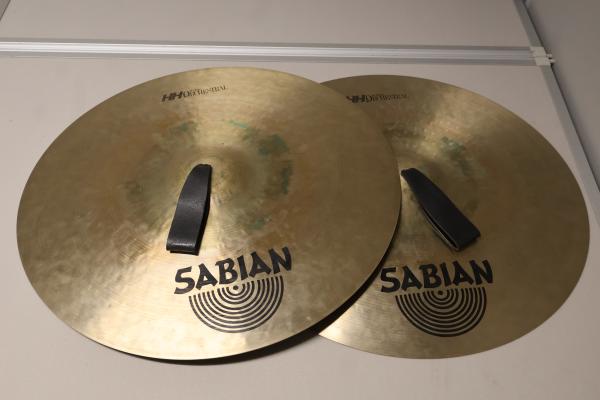

Clash cymbals are regarded as the finest examples of the cymbal-smith's art, with the best pairs being hand-hammered into shape and before being paired into identically sounding sets. Better quality cymbals are divided by thickness between the thinest, described as light or French; medium, described as (unsurprisingly) medium or Viennese; and the thickest, described as heavy, Wagnerian or German. The thicker the cymbal, the higher it is in pitch; the louder it can play; and the heavier it is (important for quick rhythmic patterns). Medium or Viennese are "default" choices. Orchestral cymbals also vary in size from around 16 inches in diameter up to 24 inches. The larger the cymbals, the lower they are in pitch; the louder it can play; and the heavier it is. The standard sizes are around 18-20 inches, with the largest (24 inches) and smallest (16 inches) being rarely used.
Clash cymbals are quite easy to damage, therefore please have a look at cymbal care below.
Suspended Cymbals
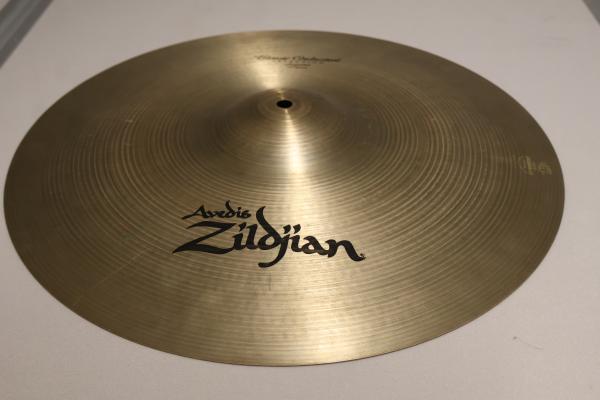
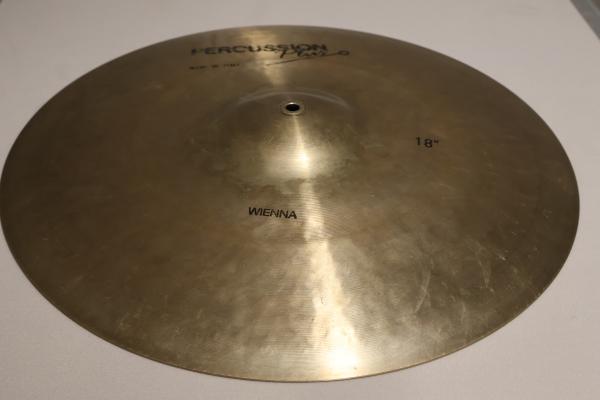
Suspended Cymbals are single cymbals which are placed on a stand and struck with a beater. They are very similar to the "crash cymbals" which appear on drum-kits. As with Clash Cymbals, they range in size, with between 18 and 20 inches being the standard sizes.
Chinese Cymbals

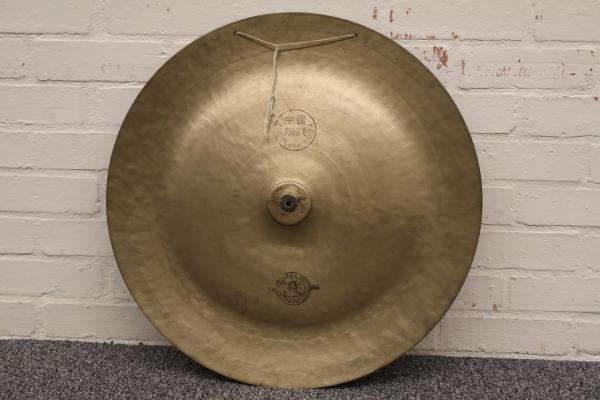
A Chinese (sometimes called "China") cymbal has a large conical bell in the middle and a convex shape. In Western Classical Music, they are most famously used in the music of Messiaen. They have much greater attack and less sustain than other cymbals in Western music and so although they are available in a wide range of sizes (from about 16 to 24 inches), this has less effect on their sound.
Splash Cymbal

A splash cymbal is a very small and quite thin suspended cymbal. When hit, it produces a strong attack with little sustain. It is mostly encountered in popular music as part of a drum kit.
Sizzle Cymbal
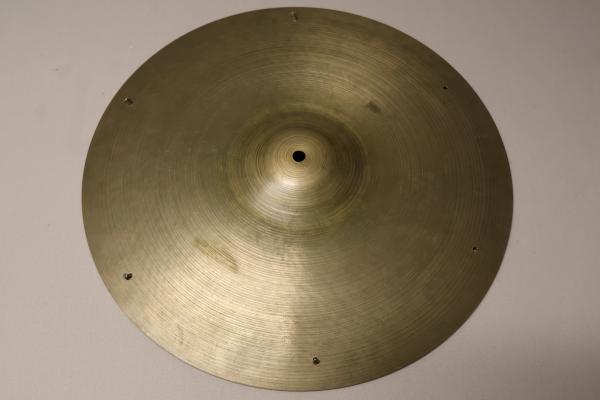
A sizzle cymbal has a number of rivets loosely installed the body of the cymbal. When the cymbal is struck, the rivets vibrate, producing great sustain and a "wash" of sound. A similar effect can be produced on a normal cymbal by the use of a "ching ring" or "chain sizzles" are placed on the top of a normal suspended cymbal.
Antique Cymbals

Antique cymbals are a pair of very small and very thick cymbals, joined by a piece of cord. Rather than having their faces brought together to sound, as happens for clash cymbals, antique cymbals are sounded by striking their edges together. They tend to have a very high pitch sound, sometimes of quite definite pitch or otherwise sounding similar to a triangle.
Crotales


Crotales are a modern version of pitched antique cymbals. Each disk is tuned to give a specific note, and the disks are then arranged in chromatic order. They are struck with beaters and give a sound similar to a Glockenspiel but with a much stronger attack.
Cymbal Care
Being thin disks of brass, cymbals are quite fragile instruments. Please try to do the following, to keep them in good condition:
- Keep the cymbals horizontal when transporting them.
- Do not rest the cymbals on the floor if it will scratch them.
- Angle cymbals towards the performer so that if a stroke misses, it will not hit the edge of the cymbal.
- If using Chinese Cymbals with hard drum sticks, invert them to avoid mis-hits denting the edge.
- Use cymbals appropriate to the dynamics you are trying to produce.


